RISE TEAM AT UNIVERSITY OF TORONTO (2018-2024)
  • Home
  • About RISE
  • Pre-prints & Open Access Pubs
  • Blog

Welcome New RAs!

10/1/2019

 
Picture
Picture
Picture
Hello all, this Mohamed Afify here, writing my first blog post for RISE! I have been working on this study for quite some time now (one summer ROP and one year RA) and I’m eager to be working on it again this year. As we start off the new year at RISE it dawned on me how much the team has changed and grown, so I wanted to take this time to introduce new team members and bid a farewell to former ones:
 
Anmul Shafiq has finished her BA in criminology and political science at UTM. She is now pursuing her MA at in public service at the University of Waterloo.
 
Dalal Badawi recently completed her MA in social work at UofT this past fall and is now working at Kid’s Help Phone.
 
On behalf of RISE team, I wish you both best of luck in your future pursuits!
 
We also have four new additions to RISE team:
 
Maleeha Iqbal who is currently completing an MA in sociology at UofT. Maleeha has worked closely with professor Maghbouleh in the past through graduate level, independent research courses as well as a published book review (http://readingreligion.org/books/securitized-citizens). Maleeha has a ton of other research experience, both qualitative and quantitative. She has conducted interviews and focus-groups with professor Jayne Baker (UTM) in a project which focused on promoting literacy and active learning in the classroom. She has also conducted her own research study where she interviewed university professors to gain an understanding of their views and experiences on student incivility. For this project, she received the Dean’s Writing Excellence Award and the Excellence in Undergraduate Research Award!
 
Fatema Isam, who graduated from UofT with a background in sociology, English literature and education. She has completed an MA at OISE in education bringing a unique, interdisciplinary perspective to the team. She's interested in interdisciplinary research that applied qualitative and mixed-methods approaches in investigating the challenges, well-being, and lived experiences of immigrants and refugees in Canada. She has done extensive research on the topics of intersectionality; well-being; disability studies; educational psychology; exploring inclusive and culturally-responsive pedagogy applied in and outside of classrooms. 
 
Mohammed Nabilsi who is a 3rd year undergraduate student majoring in criminology and psychology. Mohammed also brings an interdisciplinary perspective onto the team with special interests in abnormal psychology. Currently, he works for student housing at UTM as a Residence Service Assistant (RSA) where he helps students with day-to-day enquires and other residence related services. He initially applied for a RISE ROP, but was not able to participate. Mohammed demonstrated a passion for this work as he persisted on finding information on the study despite no previous involvement. He took initiative and contacted Professor Maghbouleh then was hired onto the team this fall. 
 
Ascil Domloge who is currently completing her BA at UTM in criminology and minoring in French and sociology. She has impressive language capabilities as she speaks (or is in the process of mastering) five different languages! Ascil heard about RISE team from former RA, Anmul Shafiq. Anmul was eager to refer Ascil as her replacement. So far, Ascil has been energetic in our meeting and seems excited to learn more about the project. 
 
The rest of RISE team and I are very much so looking forward to working with all of you in this new stage of the project! -- Afify

Laila Omar Talks RISE Team Research on Egyptian TV

9/4/2019

 
A unique feature of RISE Team, which directly impacts the design of our research study, are the transnational lives of our researchers and participants. One very basic example of this is that many of us spend at least part of Summer term away from Toronto, in places where we have strong and meaningful social ties like Syria, Lebanon, and the U.S. In Laila Omar's case, while in Egypt, she was invited to appear on television not once, but twice! In the clip above, Laila is asked to describe her education in Canada, her experience as a PhD student at UofT, and RISE Team's research with Syrian refugee newcomers. Kudos to Laila for taking on an unexpected opportunity to share our work this way!

appreciation post for RAs Mohamed Afify & Fatima Al Saadie!

8/30/2019

 
Neda here, tapping a quick end-of-summer blog post to show sincere appreciation for two of our undergraduate RAs, Mohamed Afify and Fatima Al Saadie, who were so active on RISE Team this summer.

I'm lucky to have met Afify and Fatima since their earliest undergrad days in our department's required SOC 221 (Logic of Social Inquiry) course. They began their first RAships on this project in Summer 2017 and Summer 2018, respectively. Back when our project was a small pilot study without a catchy name! Their presence at this initial stage inspired me to write the grant proposals that became our full-scale RISE project.

Beyond Afify and Fatima's important research assistance in Summer 2019 (transcribing and translating our Winter 2019 audio files from Arabic to English), they were front and centre representing RISE Team at 3 different outreach activities:

(1) a "Visions of Science" event for grade 8-12 students organized by UTM's Experiential Education Unit on July 17;

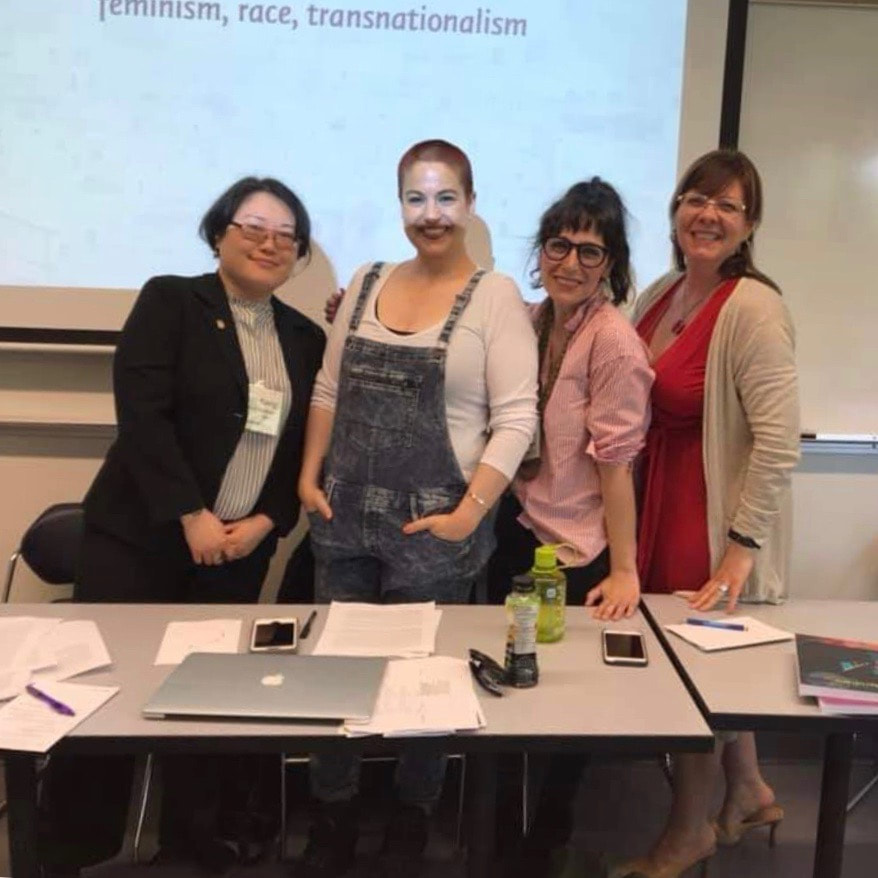
(2) two research presentations to youth and educators from China in residence at UTM's Learn to Lead program, led by Professor Liz Coulson in late July (photographed above); and

(3) a presentation on stage (!) at UTM's Smarti Gras event celebrating undergraduate research excellence on August 14.


In Professor Coulson's words, Afify and Fatima's interactions with the youth were "so positive, affirming, and patient" and the visiting Learn to Lead educators "commented many times how impressed they were with [the] work and its focus." The two RAs worked together brilliantly to brainstorm, plan, and execute these outreach activities. 

As we round the bend on their last years in our undergrad program, both RAs are pursuing offshoots from RISE Team data for their independent capstone projects, to be profiled on our blog in the future!

Thank you for making this such a special summer, "Team Smarti Gras" -- Neda

World Refugee Day 2019 at IRCC Headquarters in Ottawa

6/21/2019

 
Picture
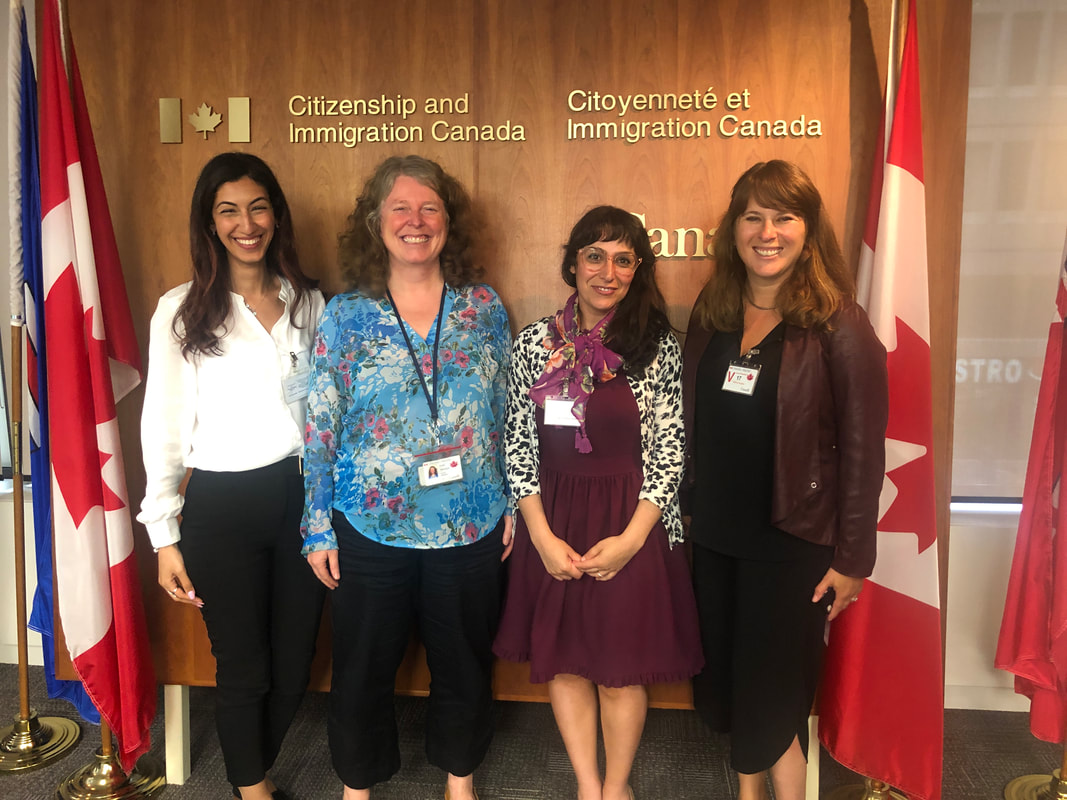
On June 20, we had the thrill of presenting RISE Team research findings to the Ministry of Immigration, Refugees, and Citizenship Canada (IRCC) in honour of World Refugee Day 2019. Our talk, "'It was like a nervous condition': Syrian Refugee Mothers' Parental Strains During Early Resettlement," is based on a book chapter (Milkie, Maghbouleh, and Peng forthcoming) from our 2016-2017 pilot study and early findings from the 2018-2023 RISE Team expansion.

The Q&A with IRCC employees was particularly energizing, as they queried us about our thoughts on family reunification policies, BVOR and PSR models of sponsorship, the relational aspects of refugee mothers' self-concepts like mastery, and much more. 

Our co-panelist was the very impressive scholar and lawyer, Dr. Shauna Labman (pictured above, far right), Associate Professor in Human Rights at the Global College, University of Winnipeg, and author of the forthcoming book Crossing Law's Border: Canada's Refugee Resettlement Program with UBC Press. At the "Research Matters" event, Dr. Labman gave a stirring, critical talk titled "A Refugee is a Refugee: Resettlement and Asylum." 

As part of their Knowledge Mobilization and Partnerships program, IRCC holds "Research Matters" events like the one held in honour of World Refugee Day at their Ottawa headquarters and the presentations are also telecast to staff posted at regional bureaus (from the invitation): Research Matters is an event series organized by Research and Evaluation where experts and scholars from different fields and from a variety of institutions present their research results. The events are designed to inform IRCC employees, stakeholders, other government departments, and interested parties about recently completed, policy relevant research from government, academia and NGO sources.

Our warmest thanks to IRCC's Mete Pamir and Lorna Jantzen, Director of Research and Evaluation (pictured above, second from the left), for the opportunity to meet and dialogue directly with the Ministry in Ottawa.

RISE Team at Congress 2019 in Vancouver, BC

6/14/2019

 
Picture
Picture
RISE Team enjoyed its second-ever trip to the Congress of the Humanities and Social Sciences this past week in Vancouver on the stunning campus of UBC. Congress is the annual convening of over 80 scholarly associations to one site for a massive conference; the Congress draws roughly ~8000 scholars from across Canada. This year RISE Team participated in panels, events, and ceremonies organized by WGSRF (Women's and Gender Studies et Recherches Féministes) and CSA (Canadian Sociological Association).

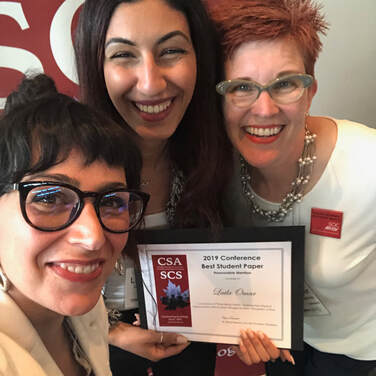
​We are especially proud that Laila Omar (PhD student and RA) won a conference-wide award: Honourable Mention, Best Student Paper for her second-year practicum paper, which uses RISE Team data to explore how Syrian mothers imagine their futures. President-elect of the CSA Dr. Tina Fetner (Sociology, McMaster University) presented the award to Laila on behalf of the award committee. 
Dr. Fetner noted that Laila's theorization of the temporal aspects of forced migration is poised to make a major contribution to the discipline. Here's to Congress 2020 at the University of Western Ontario next summer! Special thanks to our graduate department and especially the Province of Ontario's Early Researcher Award for providing financial support to make this travel possible. 

Undergraduate RA Mohamed Afify wins UofT Research award

5/13/2019

 
Picture
We are thrilled that one of our own team members,  Mohamed Afify ('20, undergraduate UTM Sociology program specialist) is a winner of the 2019 UofT Excellence Award in the Social Sciences and Humanities (UTEA-SSH). The summer salary award ($6000) encourages undergraduates of promise to "develop an appreciation for the investigative methodology of areas of particular interest, and to make informed decisions about pursuing careers in research." With the award, Afify will draw on his previous RISE Team work interviewing teenage newcomer boys to facilitate youth Participant Action Research this summer. مبروك Congratulations, Afify! 

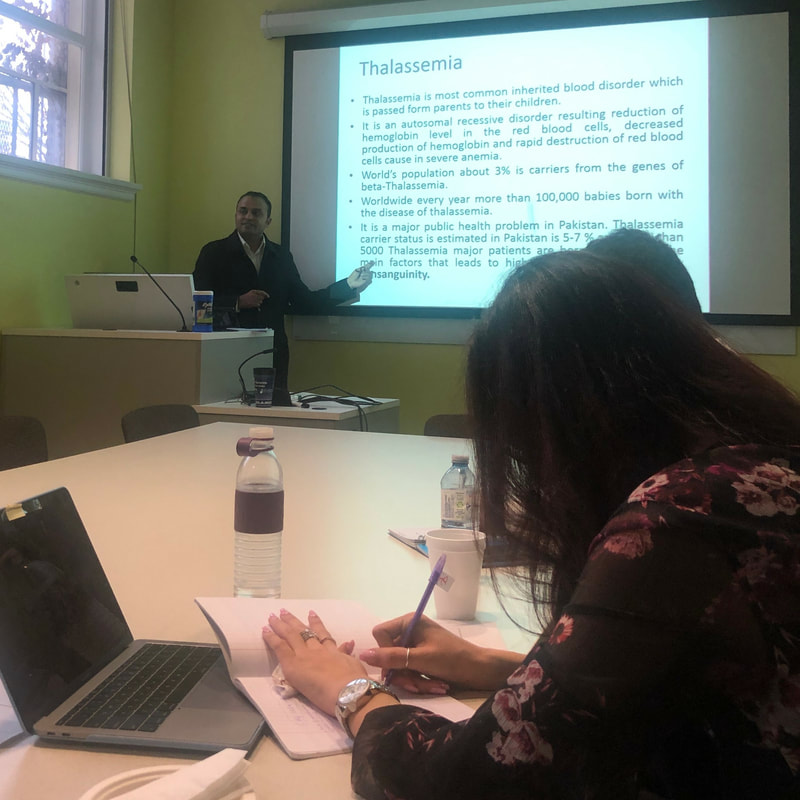
Visiting guest: Dr. Kamran Ishfaq on Thalassemia Prevention in Pakistan

3/22/2019

 
Picture
We were very lucky to have a guest speaker at last week's RISE Team meeting. Dr. Kamran Ishfaq (Assistant Professor of Sociology, Bahauddin Zakariya University Multan, Pakistan and current Postdoctoral Fellow at UofT Sociology) gave a fascinating and inspiring presentation on barriers to the screening and diagnosis of thalassemia, an inherited blood disorder, in Pakistan. 

"Prevention is better than a cure" is the guiding principle behind Dr. Ishfaq's work to develop an accessible and low-barrier educational program for thalassemia screening and diagnosis. His careful analysis takes into account gender, culture, financial strain, and other important sociological factors. 

A puzzle that motivates his work is how to adapt strategies that have led to prevention and elimination of thalassemia in  Muslim-majority countries like Iran and national contexts like Canada for use in Pakistan.

His fieldwork currently involves a large-scale study inside a public hospital which will hopefully expand into programming and screenings in schools, Universities, and other national institutions. 

Dr. Ishfaq's research is high-impact and makes a direct contribution to people's health and well-being. We wish him all the best in the next phase of his research this summer in Multan, and look forward to more conversations with him in Toronto and beyond!

Laila Omar at Oxfam UofT's "What She Knows Matters"

3/21/2019

 
Neda here! Laila Omar (@LailaMOmar) made our team very proud in a solo presentation at last Friday's "What She Knows Matters" event sponsored by Oxfam UofT. Laila was one of three invited speakers at the Centre for Social Innovation and in her remarks, she shared narratives from #RISETeam research participants about their pre-Canada experiences in refugee camps in Turkey, Lebanon, and Jordan.

Although I couldn't attend, a steady stream of texts and emails from people in the audience kept me up to date on (1) how EXCELLENT Laila's talk was and (2) the delicious catered dinner. See slideshow below! 

Sincere thanks to Naomi, Sunah, and everyone at Oxfam UofT for hosting this important conversation and fundraiser. 

UofT News Visits Our Weekly Team Meeting!

3/13/2019

 
A big thank you to Romi Levine at UofT News for hanging out at one of our recent weekly RISE Team meetings. Romi wrote up an awesome feature, timed for International Women's Day, and we're very grateful to share our project with the UofT community. The link to her original article is here: www.utoronto.ca/news/women-centre-u-t-research-syrian-refugee-experience-toronto-region 
Women at the centre of UofT research on Syrian refugee experience in the Toronto region
(by Romi Levine / UofT News)

Just over three years ago, the first wave of Syrians began arriving in Canada, fleeing the civil war that uprooted their lives and drove them to refugee camps across the Middle East and Europe.Today, those families are continuing to adjust to life in Canada – navigating their way through learning a new language, the education system and our frigid winters.

Throughout the resettlement process, a group of University of Toronto researchers have been capturing an intimate portrait of what life has been like for Syrian newcomer families.

The research group – led by Neda Maghbouleh, an assistant professor of sociology at U of T Mississauga, along with Professors Melissa Milkie and Ito Peng – is exploring how the nature of Syrian newcomers’ successes and challenges change the longer they are in Canada.

The all-women investigator team was intentional, says Maghbouleh.

“I think that's super cool,” she says. “We're not re-inventing the wheel, but in many ways we're putting feminist principles around leadership and organizing into practice.”

Women, too, are the focus of their research.

“We said, ‘What would it look like if we centred the stories of women – and not just women but mothers – as a lens into the fortunes of the family more broadly.’”

And that’s exactly what they did, interviewing 41 Syrian mothers twice within their first year in Canada.

Read more about the research initiative 

The research initiative began as a much smaller project, funded by the Social Sciences and Humanities Research Council (SSHRC) and the federal department of immigration, refugees and citizenship.

“Out of that project, we learned that one of the most significant stressors for mothers that seemed to really affect outcomes for families was how teenage children were faring,” says Maghbouleh.

Last year, Maghbouleh was the recipient of an Ontario Early Researcher Award, providing the initiative with a funding boost that allowed them to grow the research team. At the same time, they received a SSHRC Insight Grant to take the project even further.
“The goal is to involve 100 local families in the study with a particular emphasis on mothers and teenagers.”

The on-the-ground researchers all speak Arabic, so they are able to connect with Syrian families on a more personal level.

“I have assembled through sheer luck and the beauty of being in Toronto this multigenerational team of researchers here with U of T affiliations everywhere from early undergrads through people with PhDs who themselves are newcomers from the Middle East and the North Africa region,” says Maghbouleh.

"Most of us are immigrants and we've been through similar situations. It's easy for us to build rapport with them," says Laila Omar, a research assistant and PhD student in sociology, on relating to the women and teens interviewed.

Researchers are in the process of collecting data through interviews with mothers and teens – where they are often welcomed into family homes to talk over tea or during dinner.

“All of the people on our team have the insider or cultural knowledge it would take for families to so generously open up their doors, which is what they do,” says Maghbouleh.

Not only is the nature of the research multigenerational, but the research team is too.

Postdoctoral researcher Rula Kahil is working alongside her son Nour Habli, who is in fourth year studying international relations and architectural theory.

During a recent outing to interview a mother and teen, Kahil and Habli were initially hesitant to disclose their familial relationship. But once they did, they realized it was a huge help, not a hindrance.

“That somehow created ease within our interaction,” said Kahil.

During the current wave of interviews, researchers say they've noticed a significant change in the way Syrian mothers talk about their lives in Canada.

“Emotional trauma was evident in the pilot study,” says Kahil. “Now there's a big adjustment. Emotionally, the mothers are much better.”

Learning English has also helped them gain confidence, she says.

“At the beginning there was a question: What are you proud of? They were always proud of their families. Now many say they’re proud of themselves.”

The mothers interviewed say their biggest challenge is financial stability. Government-sponsored and most privately sponsored refugees were only financially supported for one year, so they are now trying to find ways to sustain themselves and their families.

“There’s this anxiety about finding work,” says Kahil. “Many of the men dropped out of school. They didn't continue their language learning because they need to supply financially so they're looking for jobs. But it's a circle because they can't find a job because they didn't finish school.”

Listen to Maghbouleh on the "View to the U" podcast

When interviewing teens, their stories reflect how much they’ve endured in such a short amount of time, says Anmul Shafiq, a research assistant and recent graduate of political science and criminology at U of T Mississauga.

Shafiq says one interviewee moved to Turkey from Syria, where her mother was diagnosed with cancer and her father was ill.
“It's so much for a 16-year-old to go through all of that and it's really eye-opening,” she says. “The interview opens up your eyes to how much they've been through and how much they're still willing to persevere and use what they've been through to give them hope in Canada.”

Expanding the research project also meant involving Syrian newcomers in the research process, says Maghbouleh.

“We have a number of refugees who are paid members of the team who support our data collection and recruiting efforts.”

Iman Abdul Razzak moved to Canada after graduating from Monmouth College in the U.S. Originally from Aleppo in Syria, Abdul Razzak left the war-torn country for Turkey around five years ago, and soon after, moved to North America for school. While her brother is in Canada, the rest of her family lives in Sweden.

“It was very difficult to adjust,” she says of moving to the U.S. at 18 years old.

But in Canada, Abdul Razzak has found community amongst her fellow Syrian newcomers, making friends and participating in local initiatives like CultureLink’s Syrian children and teen choirs.

She’s considering applying for graduate school in 2020, but is enjoying being a part of the U of T research team in the meantime, where she helps to recruit families to be interviewed.

“I relate to them. I know what they're going through because I'm actually going through the same difficulties,” she says. “When I tell them about the research and when I tell them why we're doing the research and that it actually matters to hear their voices, to hear what they want to change, they are very excited.”
​
Maghbouleh’s research group is gearing up to release its first paper on the first round of research in Meridians, an interdisciplinary feminist journal produced by Duke University Press, and a book chapter in an edited volume about Syrian refugees in Canada written by teams across the country and published by McGill-Queen's University Press.

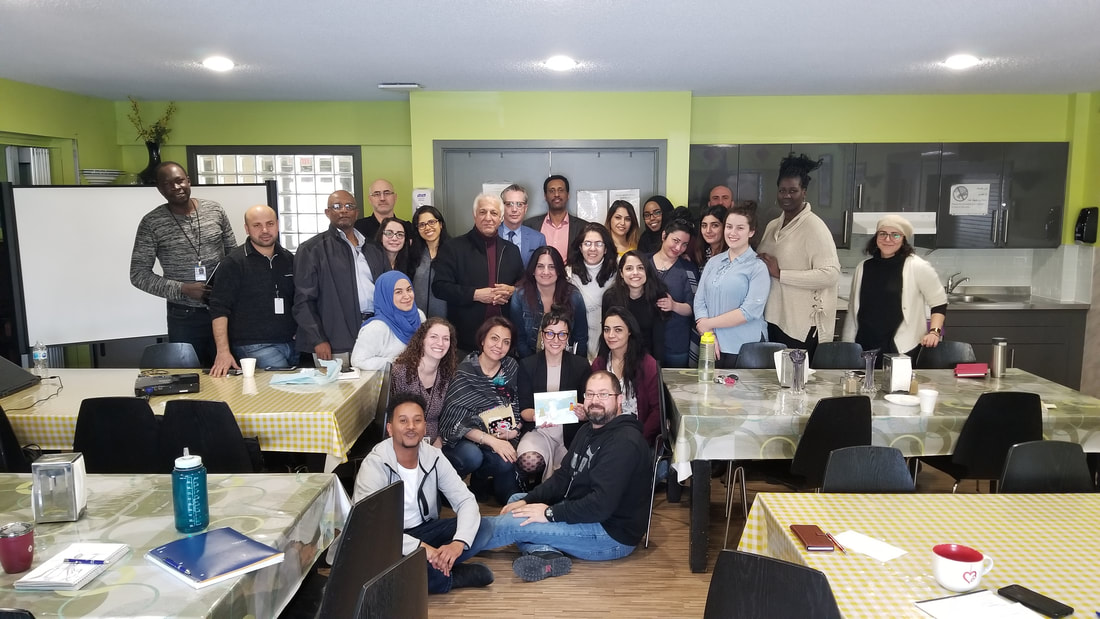
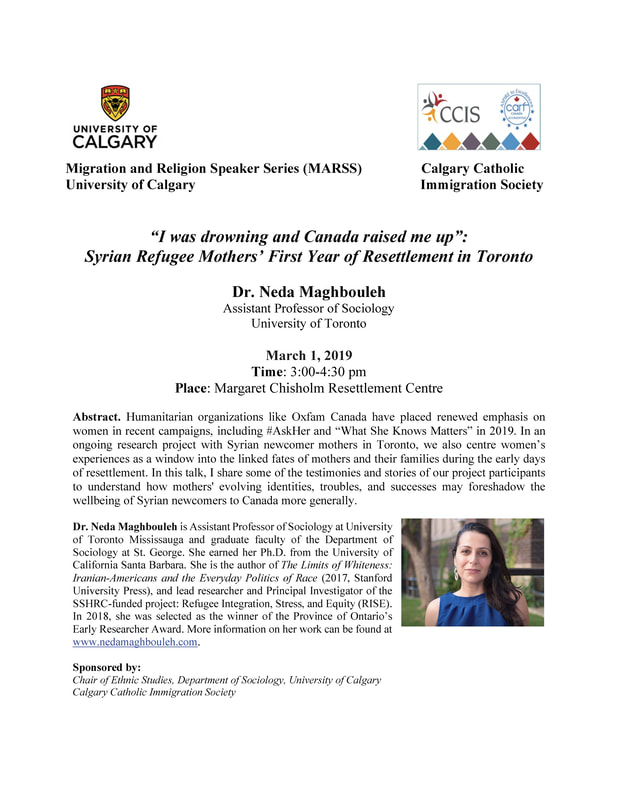
RISE Team Goes to Calgary Catholic Immigration Society!

3/4/2019

 
Picture
A quick post-talk photo with some of MCRC-CCIS' incredible people
RISE Team recently had the honour of visiting an organizational leader in the field of Canadian resettlement services since its founding in 1981, Calgary Catholic Immigration Society (CCIS). From former clients-turned-staff members to the CEO of the organization, nearly 50 CCIS leaders took time out of their busy schedules to give Neda and RISE Team crucial, expert feedback on early findings. 

Our
 Friday afternoon talk was scheduled in the sunny and welcoming kitchen of CCIS' Margaret Chisholm Resettlement Centre (MCRC), with enough strong black tea, cake, and fresh fruit to keep everyone nourished through the conversation. CCIS staff offered feedback about our research with Syrian newcomers in Toronto, including ideas for more probes around issues like familial and intergenerational conflict, suburban/urban resettlement, and entrepreneurship.

In turn, we came away with incredible testimony and evidence of CCIS' work in Alberta to share back with RISE Team in Toronto. The staff of CCIS are experts who have directly resettled 4,000+ newcomers in Calgary. The organization has touched the lives of tens of thousands of others through wraparound services including community development and rural services and family and children's services. CCIS have been early leaders in the resettlement of Eritrean, Ethiopian, Nigerian, Syrian, Yazidi, and many many other newcomer groups-- in fact there are 94 different languages spoken among CCIS' clients! The MCRC, where our talk was held, is considered by newly-arrived refugees to be their 'first home in Canada' and provides supports including three meals a day, apartment-like accommodations, recreation and play for children, and basic needs services like laundry for clients for the first 14 days after landing. For more on MCRC and CCSI, see https://www.ccisab.ca/refugees/mcrc.html.

We are inspired and excited about CCIS' research partnerships with sociologists like UCalgary's Dr. Pallavi Banerjee and we can't wait to hear more about our new friends and colleagues in beautiful Alberta. 

We sincerely thank CCIS (especially CEO Fariborz Birjandian and Manager of Resettlement and Integration Bindu Narula) and MARSS at University of Calgary for an unforgettable visit! 
Picture
<<Previous
Forward>>

    RISE Blog

    What we're up to in Toronto and beyond! 

RISE Team: Refugee Integration, Stress, & Equity